
1961 Penny Value: Why This Year Still Puzzles Collectors
In 1961, the United States Mints in Philadelphia and Denver produced a massive release of one-cent coins featuring the image of Abraham Lincoln.
The total mintage reached 2,508,727,694 specimens, distributed among production sites as follows:
Philadelphia (no mint mark): 735,905,000 units.
Denver (D mark): 1,770,314,000 units.
Philadelphia (Proof): 2,508,694 units.
Despite the significant mintage, the preservation of specimens in the highest grades remains limited, forming a high market 1961 Penny value.
The production of 1961 coins followed standards in effect before the composition change in 1982.

The primary physical parameters are:
Composition: 95% copper, 5% tin and zinc alloy.
Product weight: 3.11 grams.
Diameter: 19.05 mm.
Edge type: plain.
Weight deviations exceeding 0.13 grams are considered potential planchet errors requiring instrumental verification.
Condition Gradation and Price Indicators
The market value of a 1961 penny depends directly on its grade on the Sheldon scale and the preservation of the original red color (Red - RD).
Condition (RD) | Average Price (USD) | Auction Record (USD) |
MS64 RD | $5.00 - $10.00 | $150.00 |
MS65 RD | $15.00 - $30.00 | $345.00 |
MS66 RD | $60.00 - $120.00 | $1,265.00 |
MS67 RD | $1,200.00 - $4,500.00 | $5,500.00+ |
The record price for a 1961-P in MS67 RD grade was recorded at the 5,750 US dollar mark.
For the Denver issue (1961-D), price statistics differ due to the higher mintage and better preservation of the dies:
Condition (RD) | Average Price (USD) | Auction Record (USD) |
MS64 RD | $2.00 - $5.00 | $90.00 |
MS65 RD | $8.00 - $15.00 | $180.00 |
MS66 RD | $35.00 - $70.00 | $750.00 |
MS67 RD | $450.00 - $950.00 | $4,406.00 |
In 2024, the price for MS67 RD specimens from Denver shows an annual decrease of 5% due to the increasing population of certified coins in registries.
Proof Quality Issues
Proof quality coins were minted exclusively in Philadelphia specifically for collector sets.
The primary evaluation categories for 1961 Proof coins are:
Proof (PR/PF): A standard mirror surface without contrast. Price for PR68: $20 - $40.
Cameo (CAM): Presence of moderate contrast between the frosted image and the field. Price for PR68 CAM: $100 - $250.
Deep Cameo (DCAM): Maximum contrast, encountered extremely rarely for this year. The price for PR69 DCAM can reach $3,500 - $5,000.
The share of DCAM quality coins in the total 1961 Proof mintage is less than 0.05%, accounting for their investment status.
Identification of Manufacturing Errors and Varieties
Technical anomalies occurring during the 1961 minting process are divided into several categories.
Doubled Die
The 1961 Doubled Die Obverse (DDO) variety is weakly expressed, appearing as a slight thickening of the date digits and the letters of the word LIBERTY.
The value of confirmed DDO specimens in MS65 RD condition varies from 50 to 150 dollars.
Re-punched Mint Mark (RPM)
The 1961-D issue features multiple cases of repeated application of the "D" letter.
The 1961-D/D (North) variety is valued at $20 - $50 depending on condition.
Specimens showing clear separation of the two "D" letter contours exhibit a value growth of 7% annually.
Struck Through Errors
The entry of textile fibers or thick grease onto the die leaves blurred impressions on the coin.
Such objects are valued in the $15 - $100 range.
Factors Influencing Pricing
Evaluating the value of a 1961 penny is based on three physical surface characteristics.
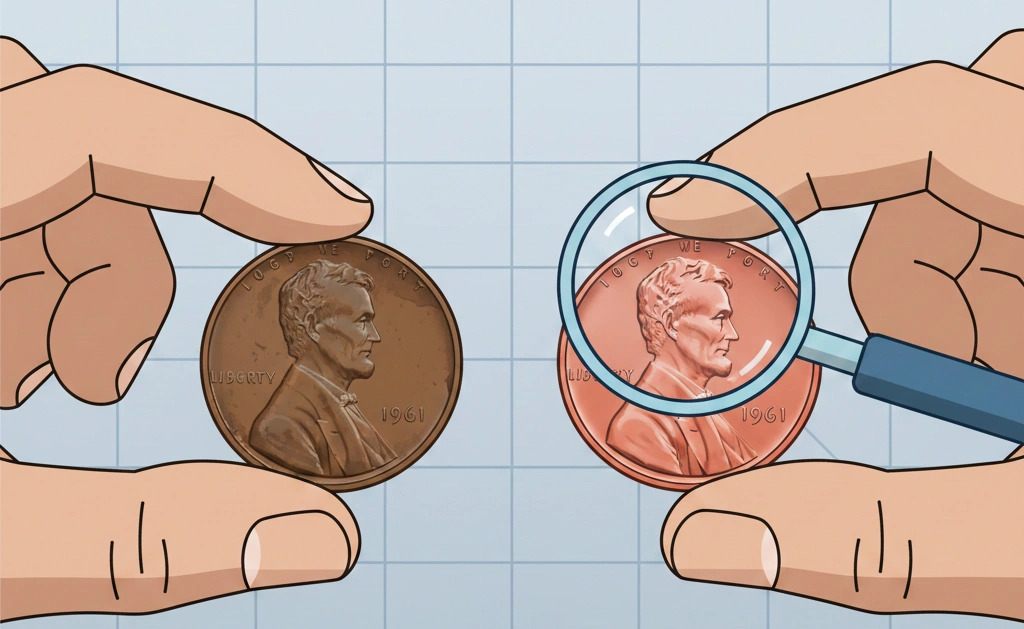
Color Preservation. Copper coins are classified as Red (RD), Red-Brown (RB), or Brown (BN). Moving from the RD to RB category reduces the coin's value by 60–90%.
Absence of Carbon Spots. Microscopic black dots appearing as a result of copper oxidation irreversibly lower the grade during professional evaluation.
Strike Quality. Weak striking of Lincoln's hair details or the wheat ears on the reverse (despite the absence of wear) prevents obtaining a grade above MS66.
Market Dynamics and Annual Volatility
Based on data for the period from 2015 to 2025, the following trends have been identified:
The value of MS65 RD coins remains stable with fluctuations within 2%.
The MS67 RD category for Philadelphia showed an 18% growth over the last three years due to the shortage of new arrivals on the market.
The number of certified 1961-D coins in MS66 grade grew by 12%, leading to a 4% decrease in their average auction price.
Mintage Survival Statistics
Analysis of PCGS and a free coin identifier population reports allows for determining the factual rarity of the highest grades.
Distribution of certified 1961-P (Red) coins:
MS65 RD: ~3,800 units.
MS66 RD: ~1,200 units.
MS67 RD: ~45 units.
MS68 RD: 0 units.
The absence of coins in the MS68 grade makes the search for specimens without a single defect the primary task when studying unsearched 1961 bank rolls.
Verification and Grading Methodology
A standard technical inspection protocol is applied to confirm the value of a 1961 coin.
Weighing. A weight of 3.11 g confirms the use of a copper planchet.
Microscopy. Using 20x magnification allows for detecting traces of cleaning or artificial luster enhancement.
Coin Appraisal App. Matching luster characteristics with reference samples from grading services.
Professional certification is a mandatory requirement for selling coins valued above 100 dollars, ensuring the asset's liquidity on auction platforms.
Conclusion
The 1961 penny represents an object with high price differentiation depending on minimal differences in surface condition.
The primary financial potential is concentrated in Philadelphia minting specimens without a mint mark possessing the MS67 RD grade.
Statistical data confirms the maintenance of high demand for Proof quality coins with deep contrast (DCAM), the value of which demonstrates resilience to general market fluctuations.
Studying the 1961 mintage requires accounting for technological features of die work from that period, often leading to the formation of small defects excluding the possibility of obtaining the highest preservation scores.